
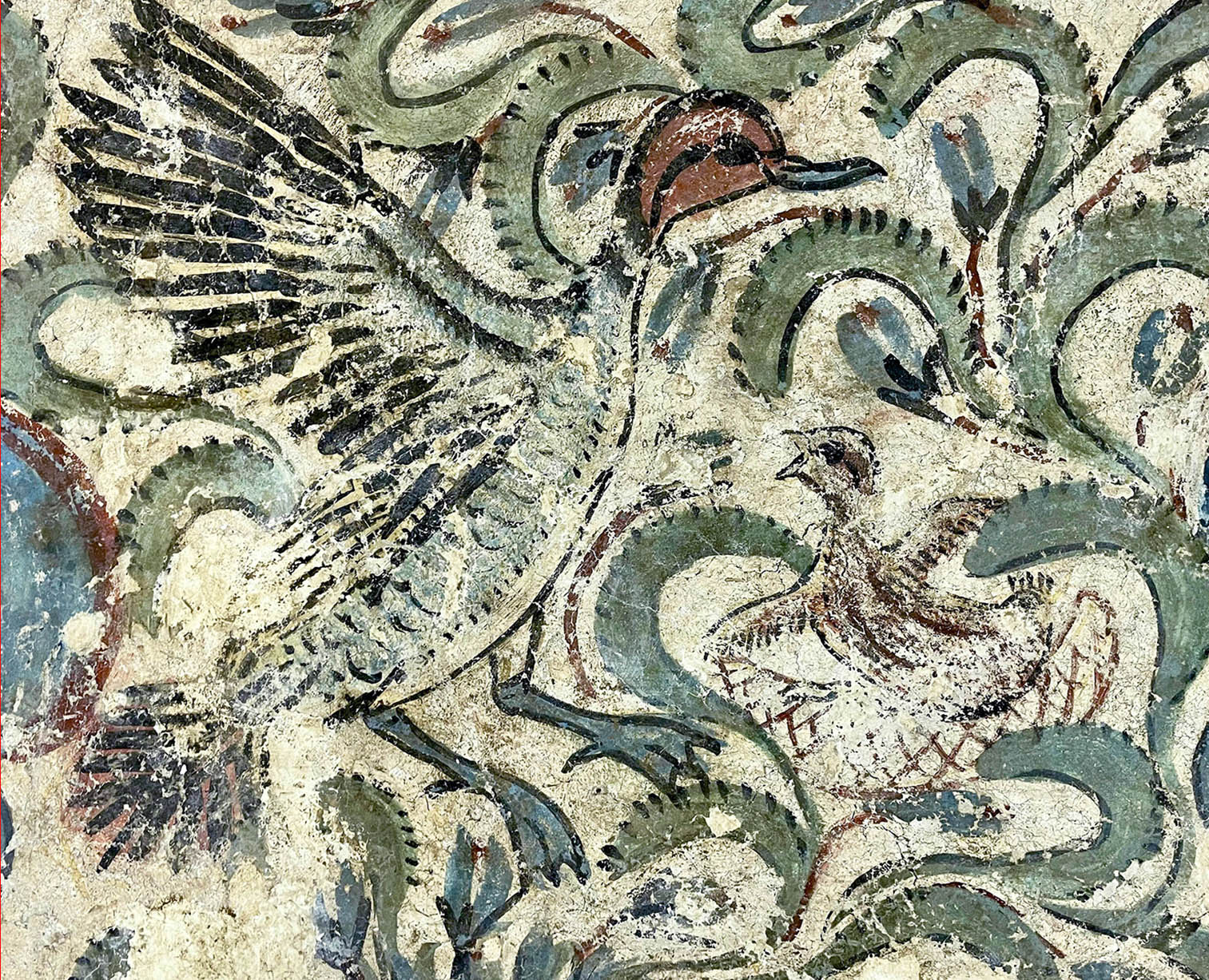
Last week marked the opening of a new permanent display at the Egyptian Museum, Cairo: the conserved wall, floor, and ceiling paintings from the Amenhotep III Painted Palace at Malqata. This multidisciplinary project, directed by Prof. Martina Ullmann of Ludwig Maximilians University in Munich, was carried out over two seasons. I led the conservation work in collaboration with colleagues from the Egyptian Museum Cairo. The project was funded by the American Research Center in Egypt’s Antiquities Endowment Fund.
These paintings were detached and excavated from the Amenhotep III Palace in the late 19th and early 20th centuries, and for decades were exhibited in different parts of the Cairo museum. Their condition varied considerably – several were in extremely vulnerable condition, and all required conservation treatment to enable redisplay and to present them both as individual pieces and as a coherent group. Our project began in September 2023 with a comprehensive assessment of each piece, examining their surfaces, substrates, and their backing systems. This first season allowed us to establish conservation methodologies tailored to the specifics of the group.
The second season of conservation work focused on treatment itself: cleaning, stabilisation, consolidation of fragile surfaces and securing each painting on its backing and within its framing device.
The ultimate objective of the project was always to redisplay, enabling visitors to experience the Malqata paintings in a meaningful context. The newly created gallery space at the museum now places them opposite the Wadi es-Sebua paintings, which we had conserved and prepared for display two years ago (see https://biancamadden.com/projects/conservation-and-research-historically-transferred-wadi-es-sebua-temple-wall-paintings/). Seen together, the two groups of paintings highlight the richness and diversity of ancient Egyptian wall painting, illustrating the differing approaches adopted in temple and royal palace settings during the same period.
These paintings are now conserved and on permanent display within the museum, where they can be appreciated as part of Egypt’s rich cultural heritage.
An article about the project can be found here: https://www.lmu.de/de/newsroom/newsuebersicht/news/vogelnester-fuer-den-pharao.html on the website of the Ludwig Maximilians University, and another is here https://www.aegyptologie.uni-muenchen.de/forschung/projekte/malqata/index.html, which has details and images of the display.