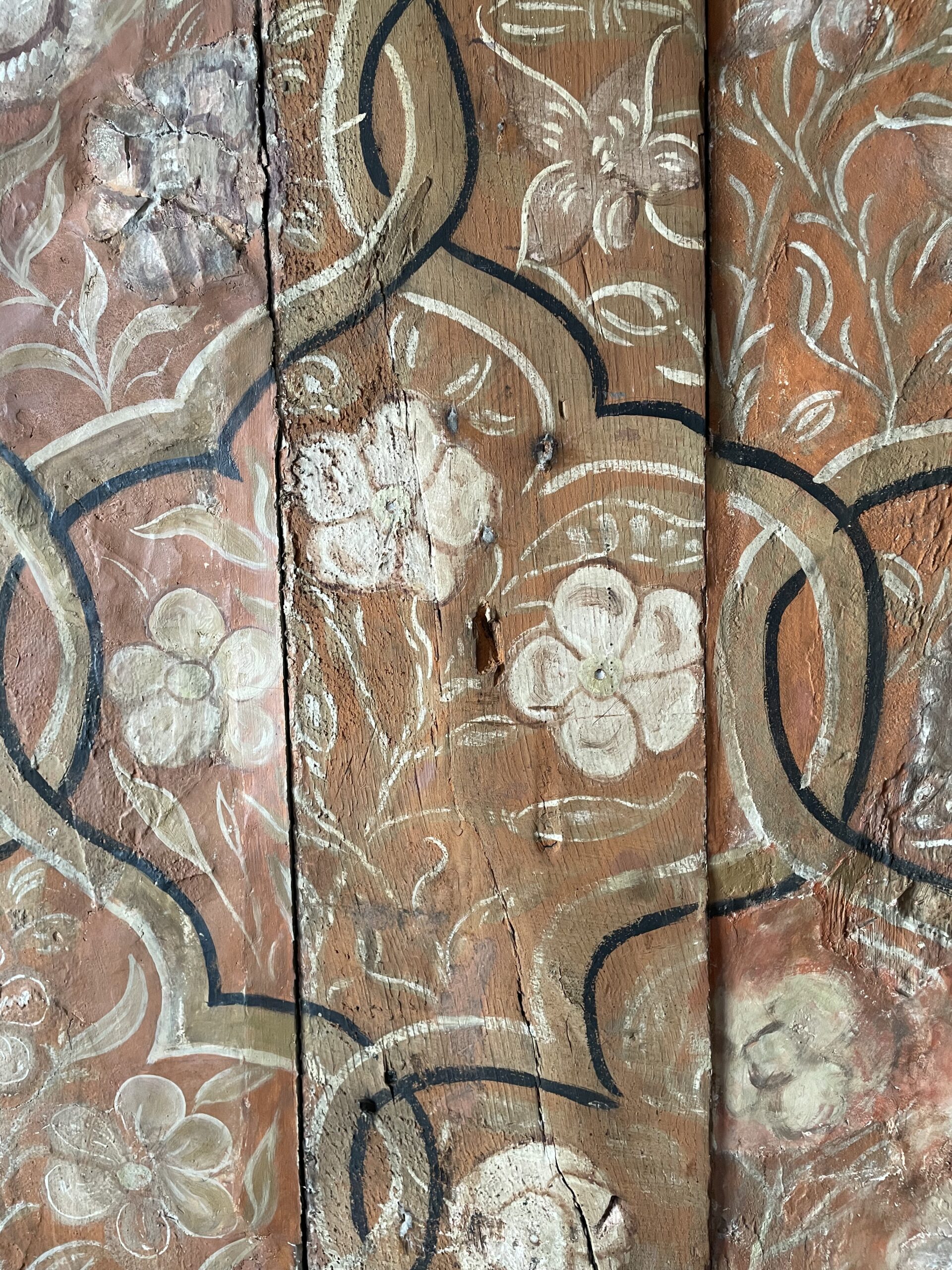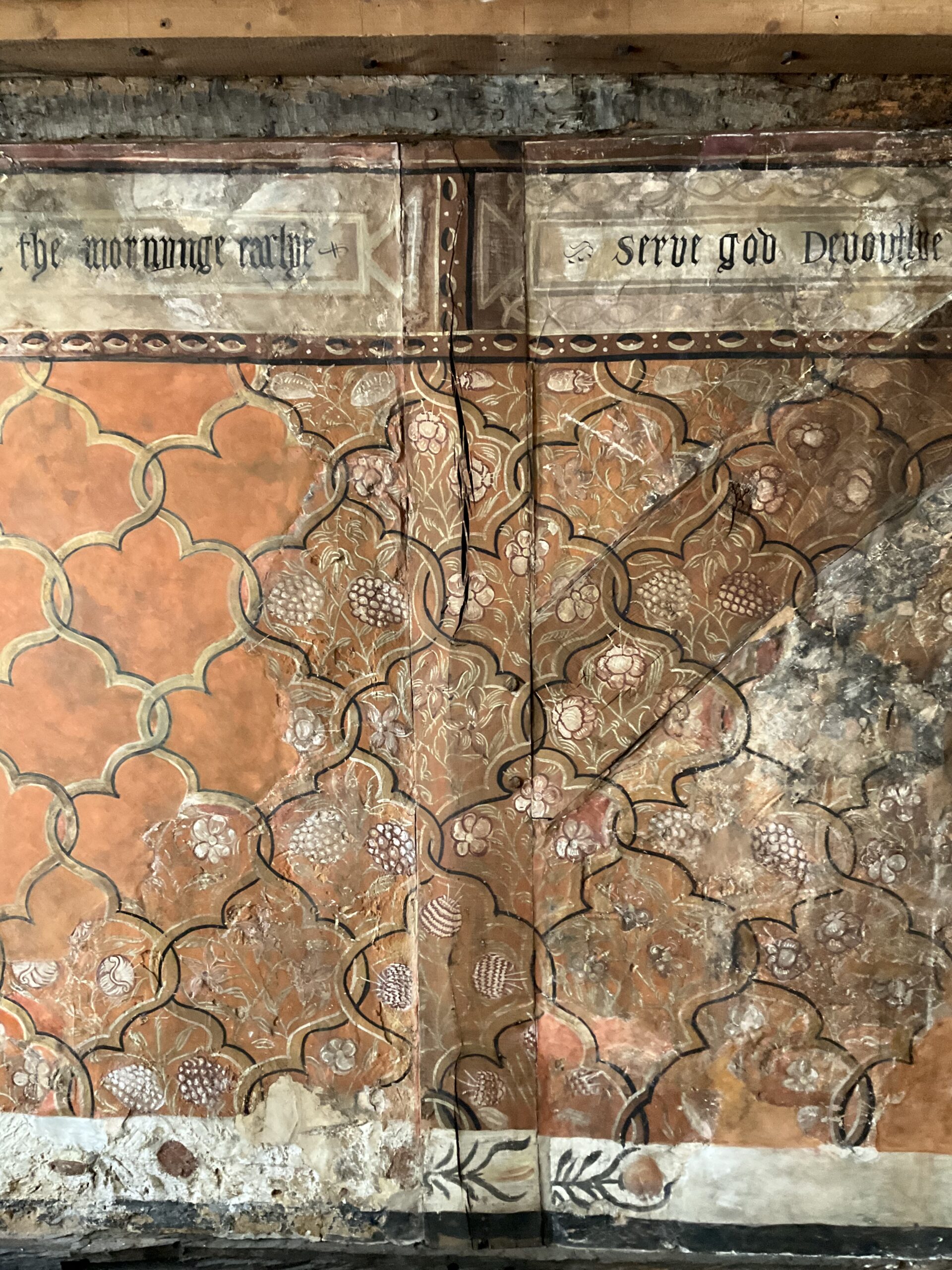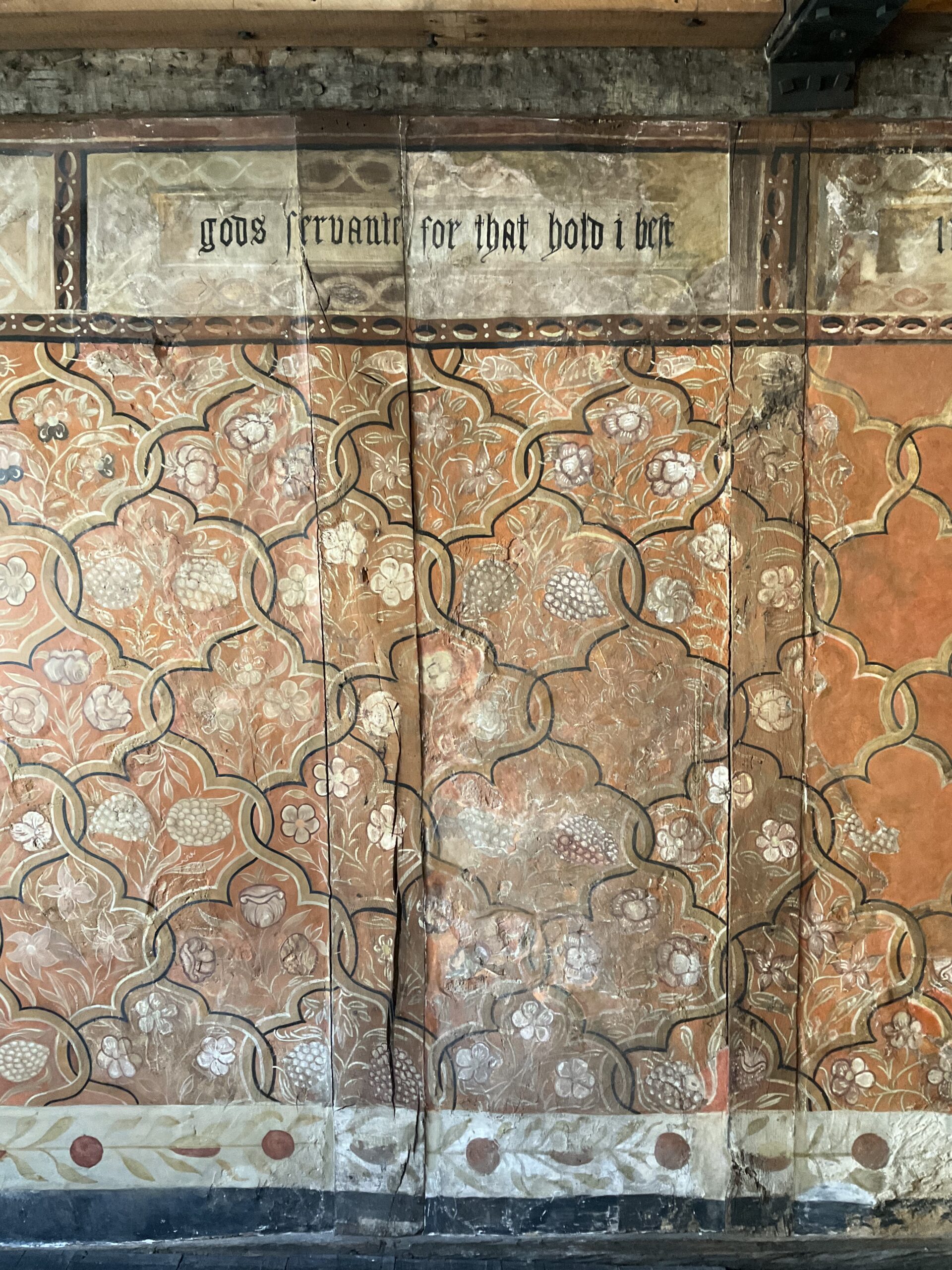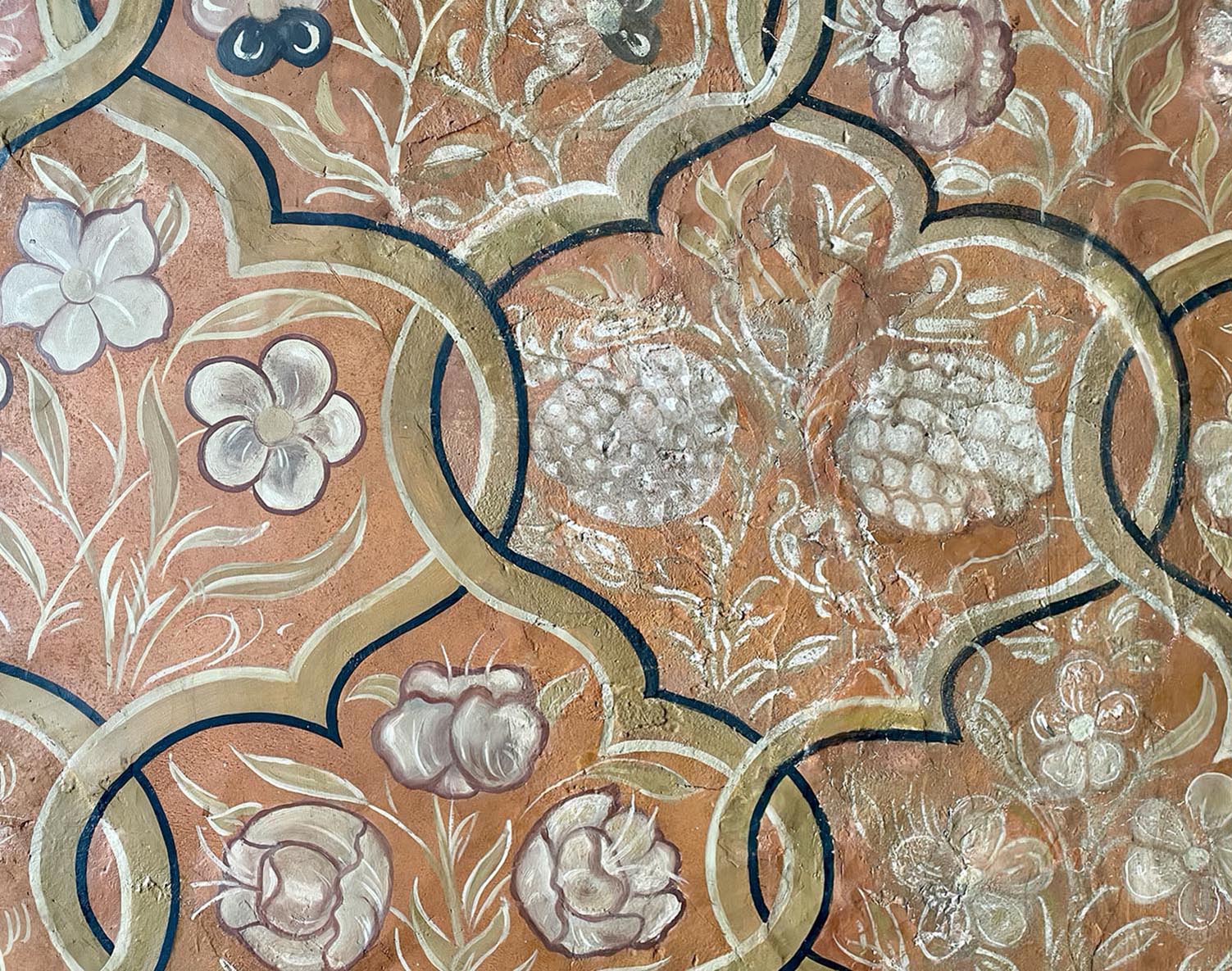
I recently undertook a survey of the wall paintings at The Painted Room – a rare survival of domestic Elizabethan decoration dating to around 1570–1580.  The room originally formed part of the historic Crown Tavern, reputedly visited by Shakespeare during his journeys between London and Stratford-upon-Avon.

The project focused on analysing the materials and techniques used to create the painted scheme.  This included investigation of pigments, plaster layers, preparatory grounds, paint stratigraphy, and glazes, and attempted to identify the binding media and the composition of the plaster substrate.  The aim was to better understand the original decorative scheme, its construction, materials, later alterations, and dating, and its context within broader 16th-century artistic practice.

The surviving wall painting extends across the plaster and timber framework of the north wall, part of the east wall, and the chimney breast on that wall.  The design is based on a strapwork pattern resembling a trellis, with fruit and floral motifs arranged within interlocking geometric compartments.

Their survival – and extent – are unusual.  Around, 1600 the paintings were concealed behind wooden panelling.  This panelling remained in place for approximately 300 years, until it was removed in 1927 during alterations to the room – and the paintings were revealed.  Since then, the room has been in the care of the Oxford Conservation Trust.
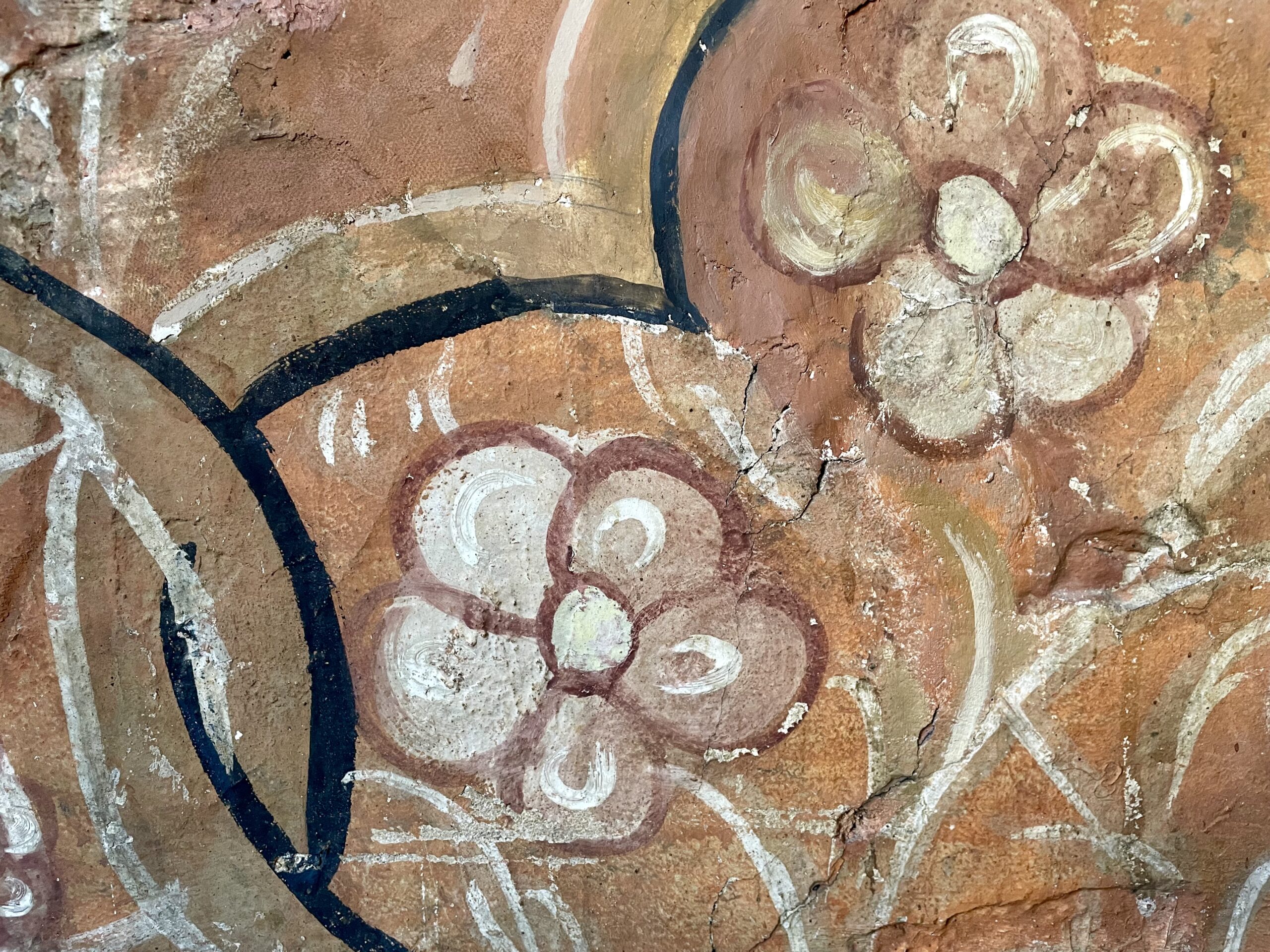
During this recent conservation project, targeted sampling and analysis were undertaken to provide insights into the materials and techniques used in both the Painted Room and surviving painted panelling in the adjacent room.  While such investigations inevitably raise as many questions as they answer, the findings indicated that, although the materials were broadly consistent with those typical of the period, the execution demonstrated a level of sophistication beyond the most basic decorative work.  The artists employed more than a simple palette of earth pigments; instead colours were layered and blended with evident technical understanding. The pigments were of good quality and finely ground, producing consistent and even tones.  Notably, the palette included more costly materials as well as standard earth colours and red lead.  The painters show confidence in techniques such as colour mixing, glazing, and modulation of tone to create depth and visual interest.  The study also found that the scheme would originally have been far more vibrant and saturated than it appears today.  Many of the pigments identified during the analysis were either light-sensitive or organic pigments of a fugitive nature, which have faded or degraded over time, resulting in the loss of much of the scheme’s original colour intensity.

Bianca Madden | The Painted Room Oxford: A Materials Study Bianca Madden | The Painted Room Oxford: A Materials Study Bianca Madden | The Painted Room Oxford: A Materials Study Bianca Madden | The Painted Room Oxford: A Materials Study